Implemented in remote rural regions of Ethiopia, Tanzania, and Kenya, the Rural Women Cultivating Change (RWCC) project is shifting the cultural attitudes, systems and structures that limit the potential of young and adult rural women smallholder farmers, particularly female heads of households, and survivors of gender-based violence.
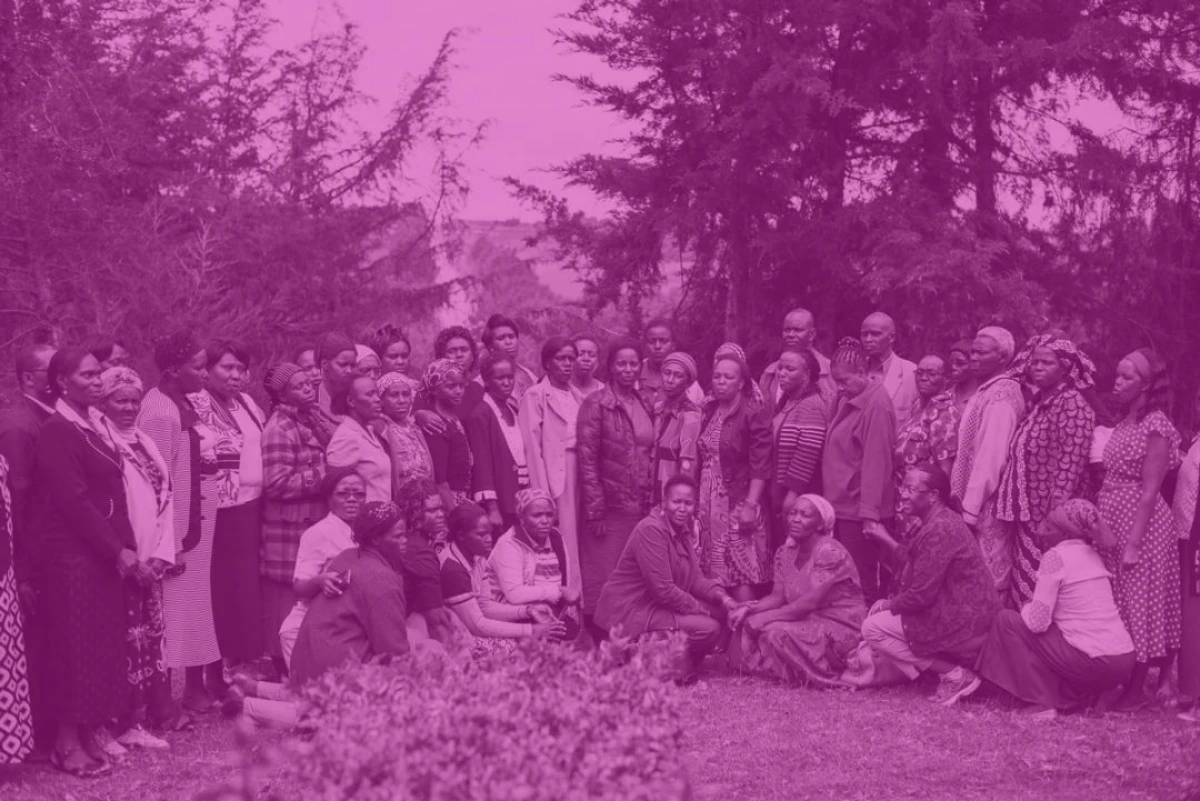
In Kenya, Rural Women Cultivating Change project is implemented in partnership with Grass Roots Organizations Together in Sisterhood (GROOTS), HIVOS East Africa (HIVOS), and Seed Savers Network Kenya (SSN). GROOTS, SSN and HIVOS are working together with their experience in leadership and mentorship programs to build on women’s sense of agency, increase women’s confidence through peer support and provide opportunities for women to undertake leadership roles.
Current project activities promote local knowledge-sharing opportunities between partners and community participants and prioritize collaborations with local women’s groups or groups where women have or need to have leadership positions. The partners in Kenya are addressing the underlying harmful social norms, attitudinal and societal barriers, and heightened care responsibilities that prevent women from fully participating in development activities. The teams are working together to advocate for the enforcement of social protection laws and policies that prevent SGBV.
GROOTS Kenya in partnership with HORIZONT3000 is currently implementing a three year governance project entitled Money Power: Enhancing grassroots women, youth, marginalized and indigenous people’s voice and influence on public budget and fiscal policy at county level in Kenya” with funding from European Union which kicked off in January 2020.
The overall objective of the action is to contribute to building strong, effective and transparent public institutions at County levels through enhanced responsive, inclusive and participatory decision making as envisioned in the Constitution of Kenya 2010 and Sustainable Development Goal 16. The action is being implemented in 2 Counties namely Muranga and Laikipia
The project proposes to utilize a grassroots-led advocacy strategy, primarily driven by the solidarity movement which constitutes women, youth, marginalized and indigenous people groups. The project purposes to tap into policy makers from the departments of Finance and Economic Planning, County Departments of Gender, Youth and Social services, County Sectoral Departments of Water/Trade & Cooperatives/ Agriculture/ Health, Members of County Assemblies (MCAs) Budget Committee, County Budget and Economic Forums, Governors and Senators, amongst other stakeholders. These duty bearers will collaborate towards a more gendered public planning and budgeting with the solidarity movement. The solidarity movement consists 100 grassroots lobby groups specifically 50 Grassroots women groups, 30 Youth groups, 20 Marginalized and indigenous persons groups.
The action is expected to realize the following outcomes; Strengthened solidarity movement of women, youth, marginalized and indigenous people, enhanced knowledge of women, youth, marginalized and indigenous people in Public Finance Management (PFM) and in political advocacy, enhanced capacity of county government to deliver effective public participation and improve public expenditure management and strengthened networking with mainstream and social media and experiences capitalized and shared.
GROOTS Kenya in partnership with Equal Measures 2030 is working with grassroots women and relevant stakeholders in Kenya to advocate for gender responsive Medium Term Plans and County Integrated Development Plans. Both the MTP111 and CIDPs are currently under development. Gender Equality Champions trained under this project are spearheading community-led monitoring of the implementation using an agreed set of indicators.
To kick start the project, GROOTS Kenya developed the SDGs Monitoring Framework to equip grassroots women and their communities with the capacity and evidence to monitor progress on the localization of agenda 2030 by national and local governments with a key focus on gender equality.
GROOTS Kenya further trained 42 trainers of trainers who will in turn train other community members on the SDGs to create a critical mass of gender equality champions in Kiambu, Kakamega and Laikipia Counties.
The champions have already selected 12 goals, 23 targets and 25 indicators to monitor, against the 17 global goals, 169 targets and 232 indicators. Their selections are based on the priority needs within their communities.
The data collected will be the basis on which the advocacy begins.
Partners-EQUAL MEASURES
Beneficiaries - 5 counties: Kitui, Nakuru, Laikipia, Kiambu and Kakamega.
Through three projects, Women Political Representation Enhanced, Strengthening Electoral Processes in Kenya and Gender Implementation Tracking, GROOTS Kenya aims to contribute to enhanced gender equality through an increased proportion of women in elective positions at the county and national levels by the end of the 2017 General Elections in Kenya. This is done through a grassroots- led demand for an enabling political environment, focusing on accountability within popular political parties in the counties of Kiambu, Laikipia and Kakamega.
The projects also focus on the creation of a positive image of women leadership at the grassroots level, reduction of electoral violence against women through use of community watchdogs and popularizing of women candidates nominated by political parties through the champions for transformative leadership model.
Launched in 2014, the Gender Equality Implementation Tracking is a grassroots women led initiative that monitors implementation of gender in Kiambu, Laikipia and Kakamega by grassroots women or champions who then help to influence policy and decision making.
The projects are supported by We Effect, UN Women and the European Union.
The project has progressively applied the Champions for transformative leadership model developed by GROOTS Kenya to pursue increased and enhanced women leadership and governance in Kenya. The model which was developed in 2008 is composed of a critical mass of organized groups of grassroots women, men & youth who passionately believe and sustainably champion for increased number and enhanced quality of women in elective, nominative and appointive leadership position.
The model strategically targets men’s support for gender equality as a core prerequisite to transformative development. To date the model has contributed to the election, nomination and appointment of grassroots women in decision-making platform such as the County Assemblies, County Executive, National and County committees, institutional boards as well as local administrators. The model is keen at developing the capacities of young girls from urban and rural poor communities through mentorship and skills development with an overall goal of building a transgenerational movement.
Through the model GROOTS Kenya has consistently supported the organized groups to drive demand for accountability from duty bearers. In line with this GROOTS Kenya developed a grassroots women-led Gender tracking framework & tool for counties. The tool has been piloted in Kakamega, Kiambu and Laikipia county in the agriculture, education, water sector. The tool is currently used to generate gender related data in regards to numbers and access to basic services for evidence based advocacy at the counties. The project has from time to time received support from UN Women, Kenya, UN Women-Fund for Gender Equality, Henrich Boll Foundation (HBF), African Women Development Fund (AWDF),We effect, Diakonia Sweden, European Union & Huaroiu Commission & PACT Kenya.